
The Rules of Chess
Every rule, in plain words
Chess has only a handful of rules, and every one of them is on these pages: how the pieces move, how a game is won, and the three special moves that surprise new players. If you would rather learn by doing, La Reina's School teaches the same rules on the board, one small step at a time, and the first 5 units are free.
The board
Chess is a game for two players, White and Black, on a board of 64 squares, eight by eight, light and dark in turn. The rows that run across the board are called ranks, numbered 1 to 8 from White's side. The columns are called files, lettered a to h from White's left. Every square is named by its file and rank, so e4 is the square where the e-file meets the fourth rank.
Turn the board so that each player has a light square in the corner on their right. It is the most common setup mistake, and getting it wrong puts the king and queen on the wrong squares.
Setting up the pieces
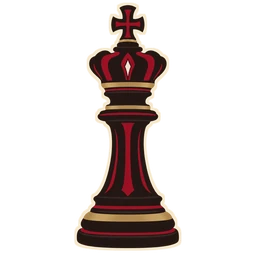
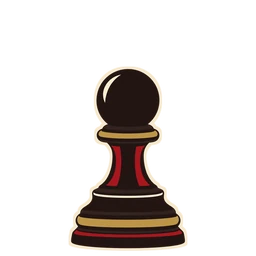
Each side has 16 pieces: one king, one queen, two rooks, two bishops, two knights and eight pawns. The pawns fill the second rank (the seventh for Black). Behind them, from each corner inward, come a rook, a knight and a bishop. The queen and king take the two squares in the middle, and the queen goes on her own colour: the white queen on a light square, the black queen on a dark one. The kings face each other across the board, and so do the queens.
 8
8
 7
7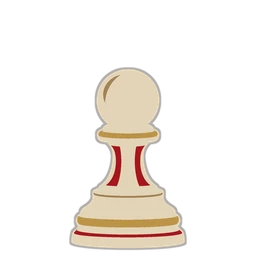 2
2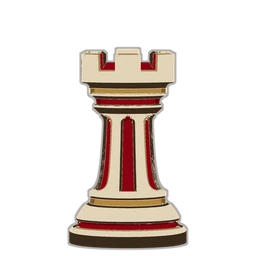 1a
1a b
b c
c d
d efgh
efghWhite always moves first. After that the players take turns, one move each, and nobody may skip a turn.
How a game is won
The goal is to checkmate the other king: attack it so that it has no way to escape. The king is never actually captured. The moment it is checkmated the game is over, and the side that gave checkmate wins.
A player may also resign, giving up the game, and the other player wins. Not every game has a winner: some end in a draw, as below.
How the pieces move
| Piece | How it moves | Worth |
|---|---|---|
| King | One square in any direction. It may never move onto a square an enemy piece attacks. | The whole game |
| Queen | Any distance in a straight line: along a rank, a file or a diagonal. | 9 |
| Rook | Any distance along a rank or a file. | 5 |
| Bishop | Any distance along a diagonal, so it stays on one colour all game. | 3 |
| Knight | In an L: two squares one way, then one to the side. It jumps over anything in between. | 3 |
| Pawn | Forward one square, or two from its starting square. It captures one square diagonally forward. | 1 |
Apart from the knight, no piece can jump over another: its path must be clear. A piece captures by moving onto the square of an enemy piece, which is taken off the board, and no piece may land on a square held by its own side. The worth of each piece is not a rule, just the guide every player uses to judge a trade. More on each piece, with boards: how the chess pieces move.
Check and checkmate
When a piece attacks the king, the king is in check, and its player must get out of check on the very next move: by moving the king, by blocking the attack, or by capturing the attacker. Nobody may make a move that leaves their own king in check. When there is no way out, it is checkmate. The details, and the trap called stalemate: check, checkmate and stalemate.
The three special moves
- Castling. Once per game, the king can move two squares toward one of its rooks, and that rook jumps over to the square on the king's other side. Only if neither piece has moved, the squares between them are empty, and the king is not in check and does not pass over or land on an attacked square. Castling in full.
- En passant. When a pawn moves two squares from its starting square and lands right beside an enemy pawn, that enemy pawn may capture it as if it had moved only one square, but only on the very next move. En passant in full.
- Promotion. A pawn that reaches the far end of the board becomes a queen, a rook, a bishop or a knight, its player's choice. Promotion in full.
How a game is drawn
A game is drawn when:
- the player to move is not in check but has no legal move (stalemate)
- neither side can possibly checkmate, as with king against king (not enough material)
- the same position appears three times (threefold repetition)
- fifty moves each pass with no capture and no pawn move (the fifty-move rule)
- both players agree (a draw by agreement)
The draw rules in full, including how tournament players claim them.
At a real board
Tournament games add a few rules of their own that an app takes care of for you.
- Touch-move. On your turn, if you deliberately touch one of your own pieces, you must move it, if it has a legal move. If you deliberately touch one of your opponent's pieces, you must capture it, if you can.
- Adjusting. To straighten a piece on its square without having to move it, say "I adjust" (or "j'adoube") first.
- Clocks. In a game with a clock, a player whose time runs out loses, unless the opponent has no possible way to checkmate, in which case it is a draw.
Learn it on the board
La Reina's School teaches all of this on a real board, one rule at a time, and explains every mistake in plain words. The first 5 units are free:
- Unit 1: How the pieces move. One piece at a time, on a quiet board, until every move feels natural. Lessons: Welcome to the board, The rook, The bishop, The queen, The king, The knight, The pawn.
- Unit 2: Taking and protecting. What each piece is worth, how to grab what is free, and how to keep your own pieces safe. Lessons: What pieces are worth, Protected pieces, Spot the free piece.
- Unit 3: Check, checkmate, stalemate. Attacking the king, escaping an attack, and the trap that ends the game. Lessons: Check, Getting out of check, Checkmate, Stalemate.
- Unit 4: The special rules. Castling, promotion and en passant: three rules every player needs. Lessons: Castling, Promotion, En passant.
- Unit 5: Your first full game. How a game begins, then a whole game with La Reina at your side. Lessons: How a game begins, Your first game.
Where these rules come from
These pages follow the FIDE Laws of Chess, the rules played in tournaments worldwide. Where La Reina's board applies a rule differently from a tournament, as it does for two of the draws, the page says so.